
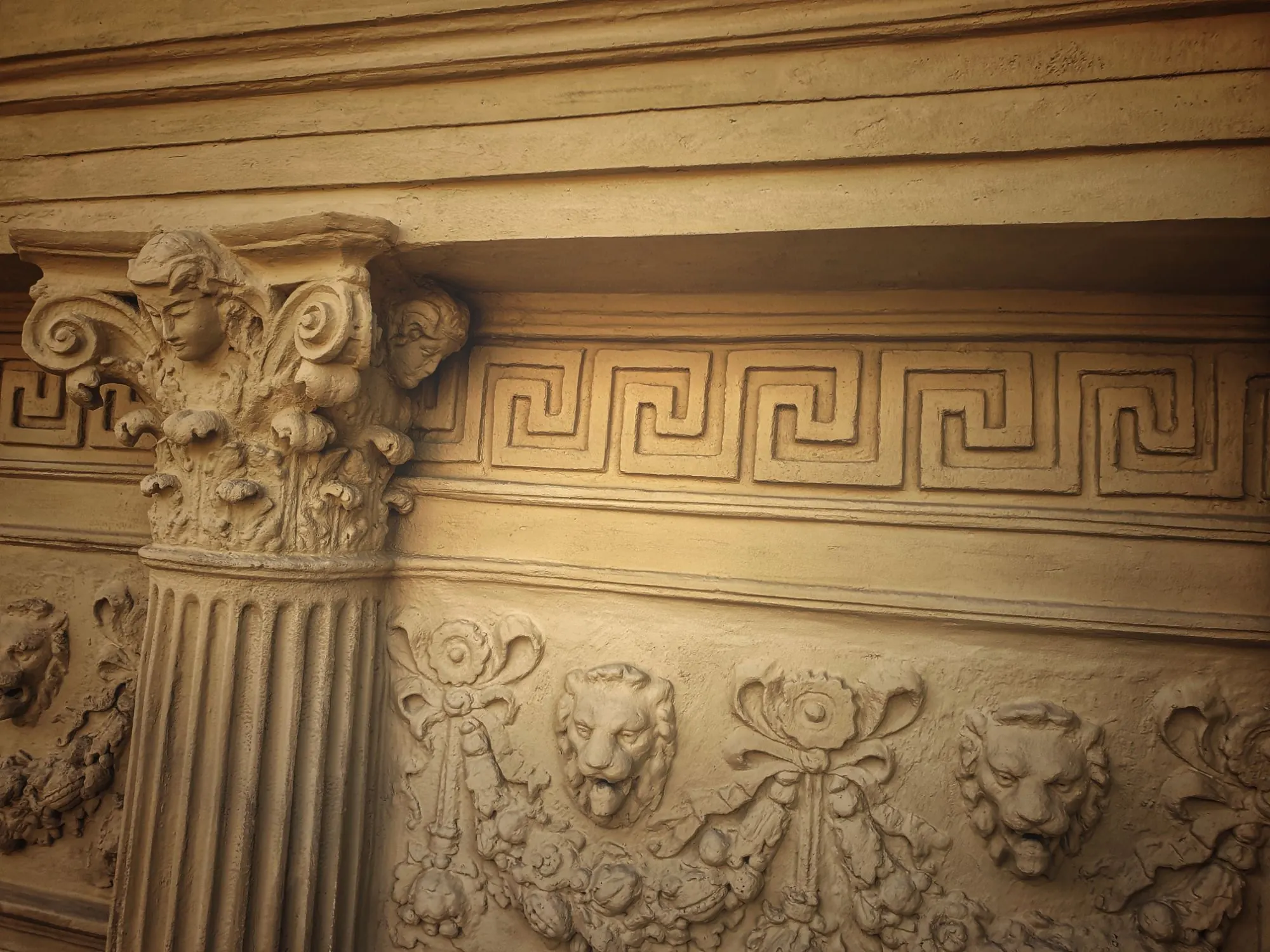
Restoration · Kristinehamn, Sweden
Capitals, frieze & relief restored
A historic town-house facade: fluted pilasters with figured capitals, a Greek-key frieze and garlands with lion masks — rebuilt by hand where they had fallen away.
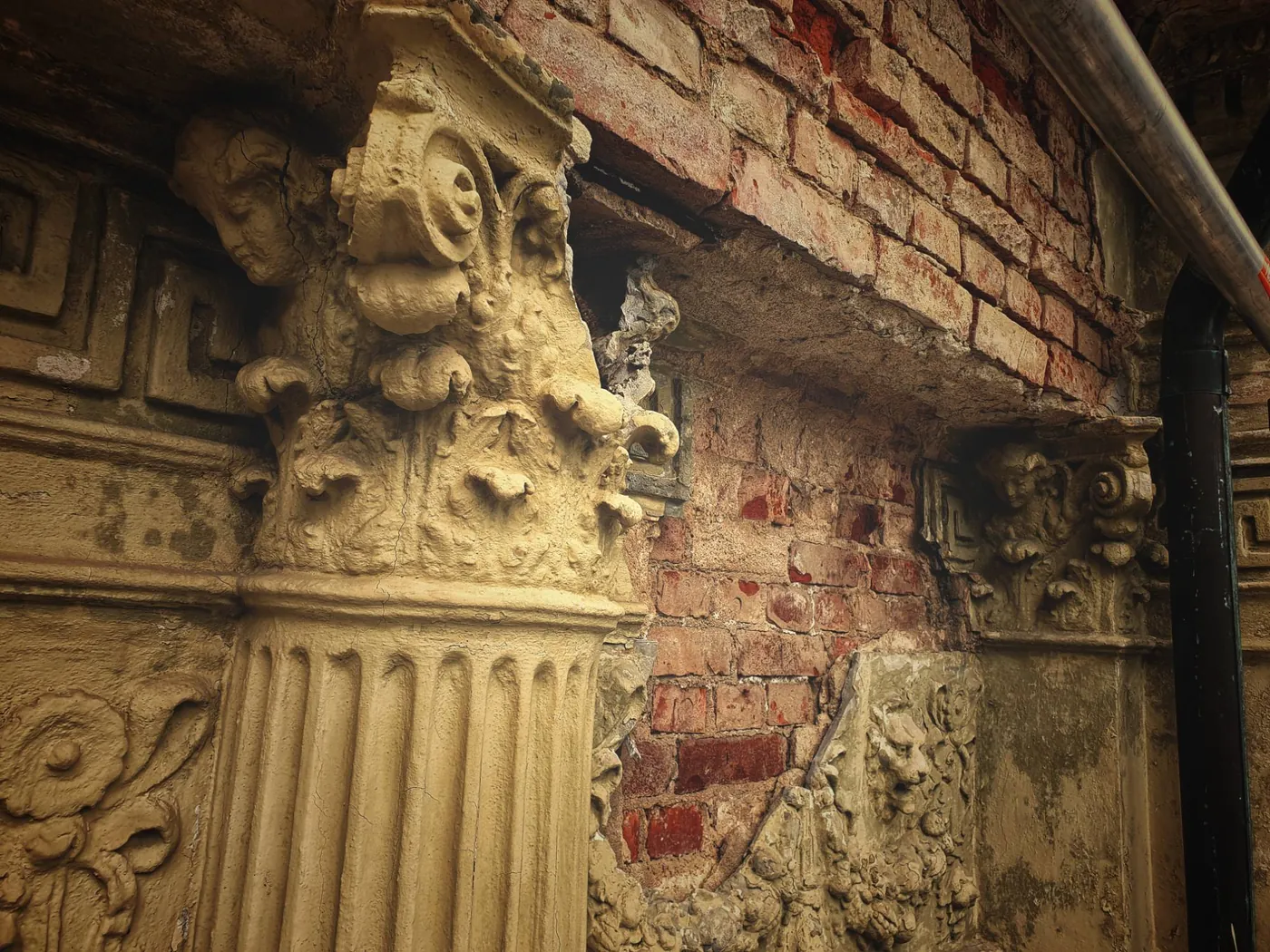
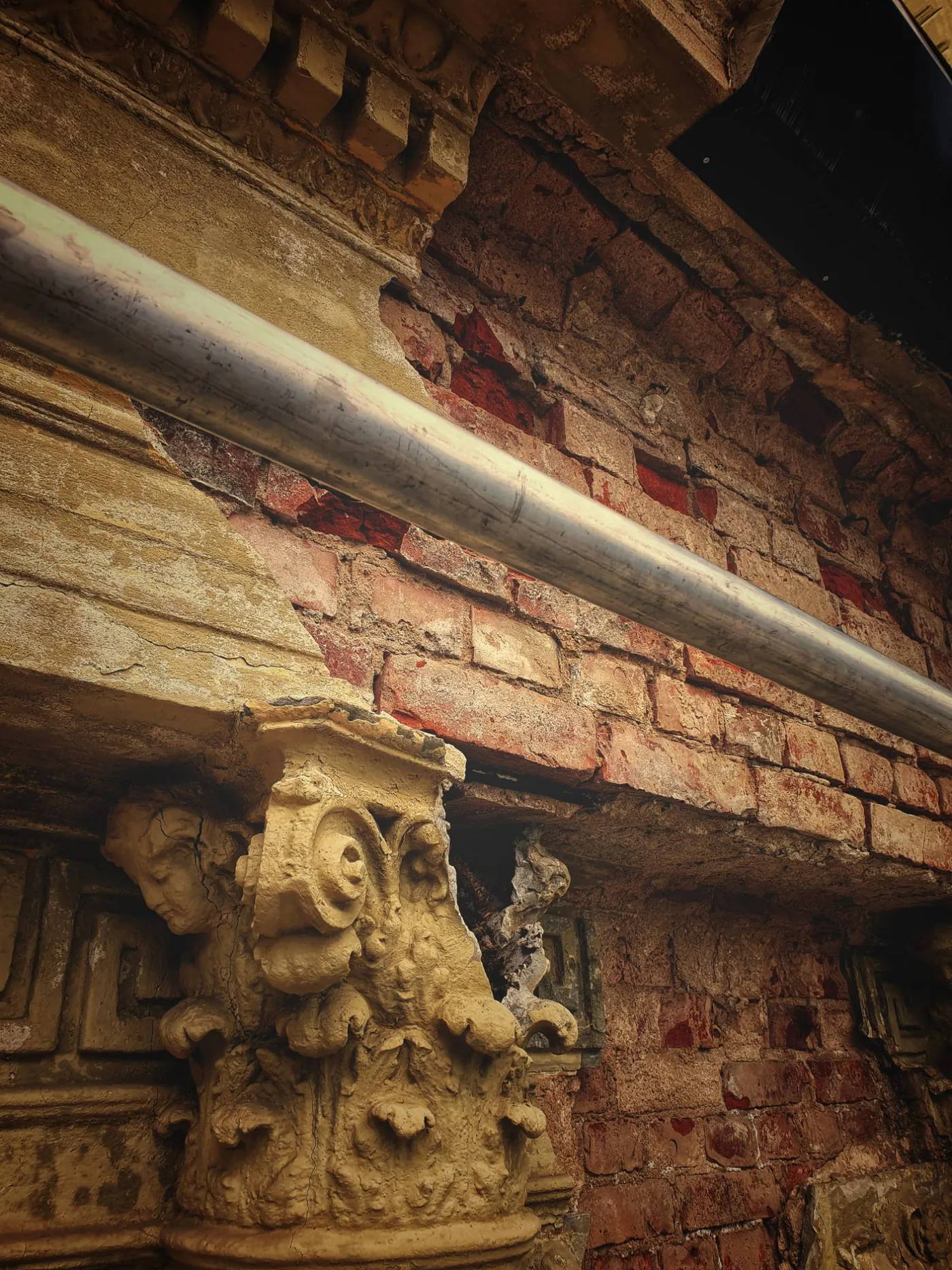
Before
The cornice and frieze had lost whole sections down to the brick; capitals were cracked, leaves and scrolls broken off, the lion-mask frieze split and stained.
After
Missing parts modelled again by hand from the surviving pieces: the Greek-key frieze, the capitals with their heads and scrolls, the garlands and lion masks. The whole entablature was then rendered and painted as one surface.
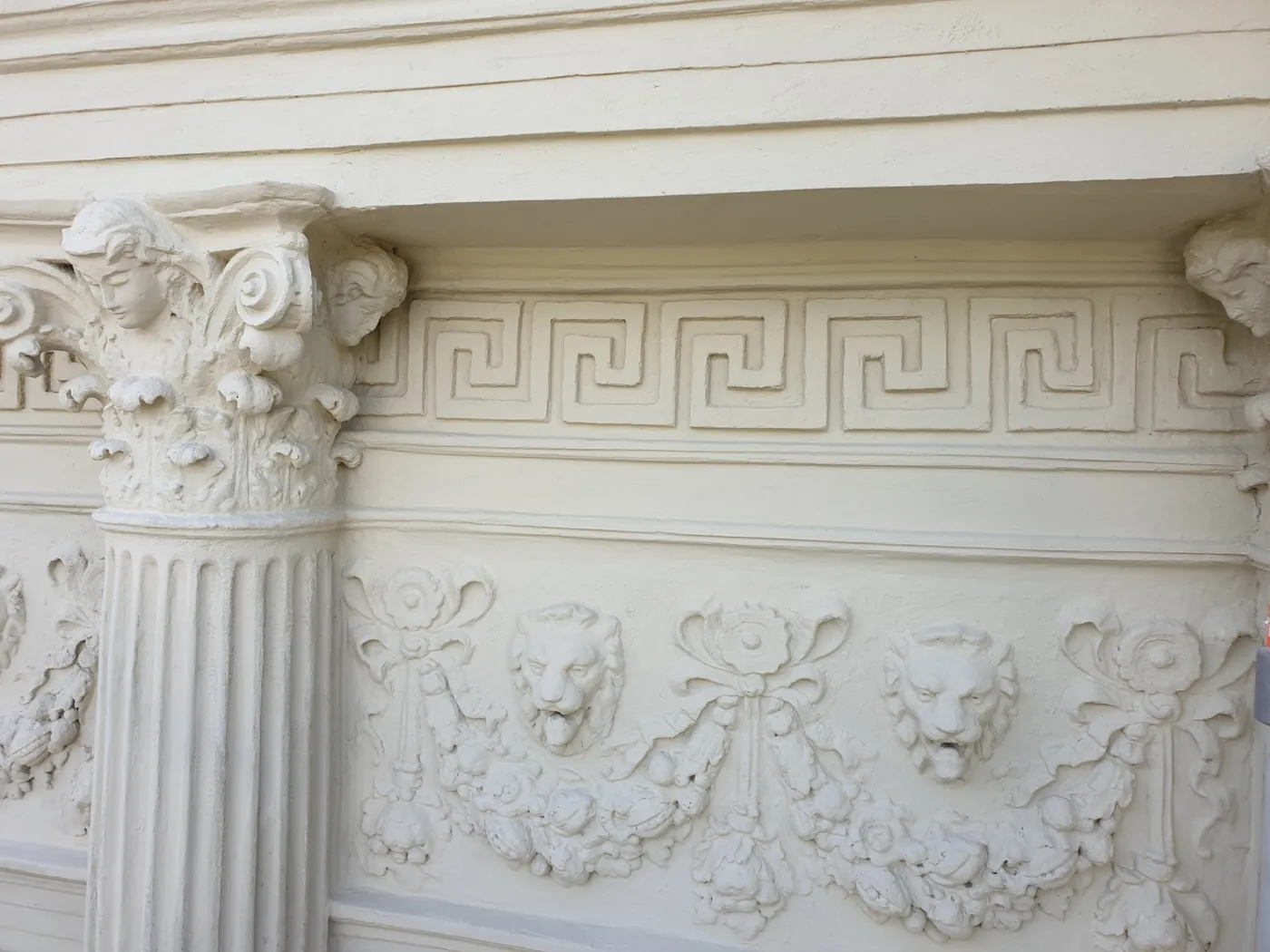
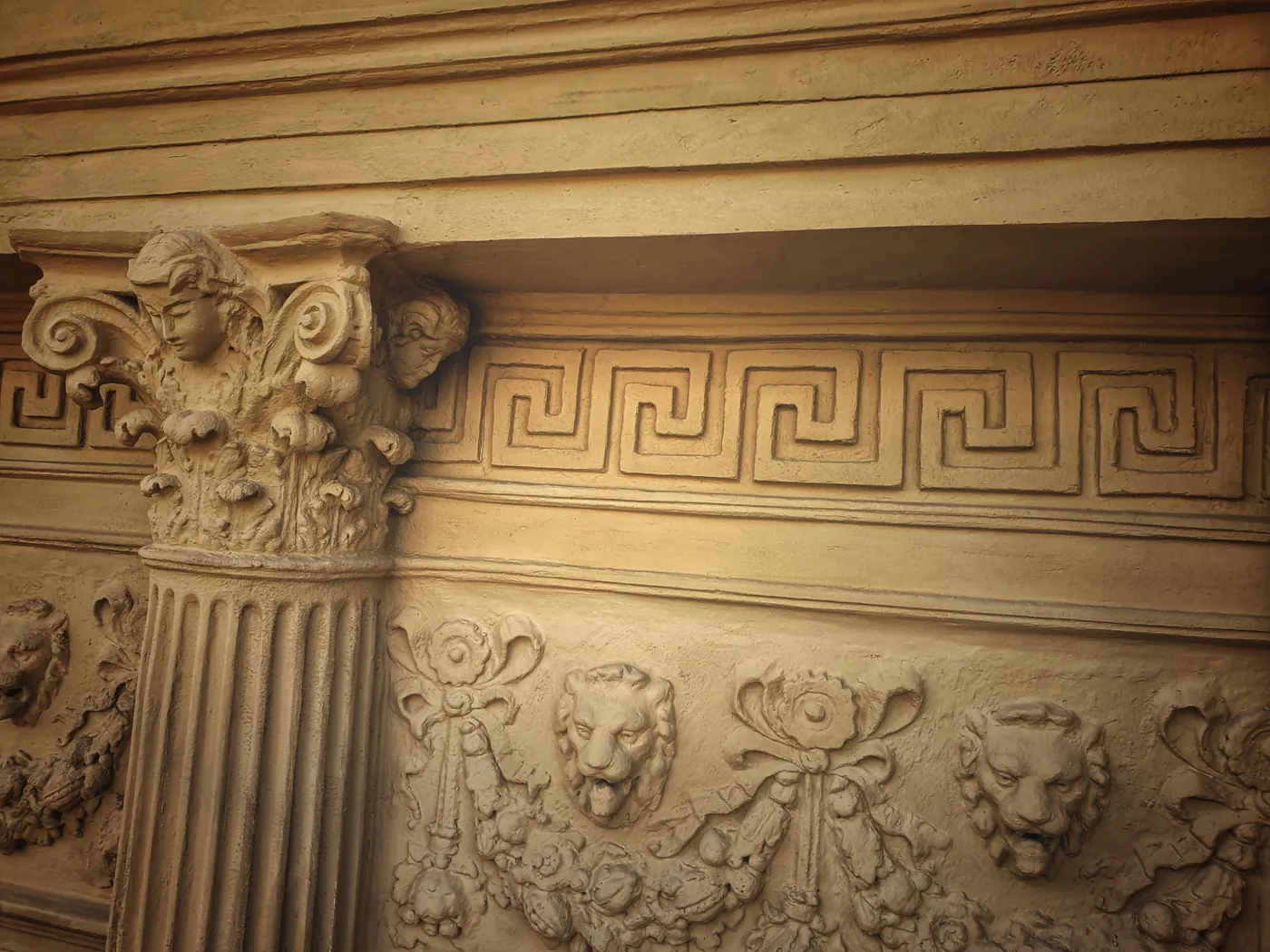
What the elements are called
- Pilastera flat half-column built into the wall, here fluted (vertical grooves)
- Figured capitala Corinthian-type capital with acanthus leaves, volutes (scrolls) and carved female heads
- Greek key (meander)the continuous right-angled band in the frieze
- Festoons with lion masksswags of fruit and flowers tied with ribbons and rosettes, between lion heads
- Cornice with dentilsthe projecting top band with small block-shaped teeth
Video
The work on film
Close views of the capitals, the lion masks and the damaged layers under the ornament, from the Morabyrån facade.
YouTube videos load only after you click play.
The building
Morabyrån: why the details go first
The historic Morabyrån building has a richly ornamented facade: columns, Corinthian capitals, mascarons, a Greek key frieze and cornices. It is one of our projects in Sweden, where the company’s founder moved in 2018.
Details like these give an elevation its character, but they are also the most exposed to water, frost and time. When an ornament loses fragments, the problem is not only aesthetic: the damaged area collects water and the exposed layers deteriorate faster. It pays to plan detail restoration while the losses are still small. The longer water works on a damaged ornament, the more of the original form has to be rebuilt later.
How we approach it
The order matters as much as the craft.
Diagnosis first
We assess the existing condition: the type of substrate, the materials used before and the cause of the damage. Only then is the method chosen. In historic buildings the cause is often water running down cornices, leaking flashings or an earlier repair in an incompatible material. If the cause stays, even a well-recreated detail will fail in the same place.
Prepare the surface
Damaged or unstable areas are prepared before new layers go on: cleaning, removing weak fragments, repairing the substrate, local strengthening and re-sculpting. The new material must be compatible with the existing structure.
Recreate by hand, in place
Acanthus leaves, the features of a mascaron and the rhythm of a Greek key are sculpted on the facade, matched to the surviving fragments: depth of relief, rhythm of the ornament, character of the edges. A detail must not look like a new cast set into an old wall.
Colour against the original
Colour is matched to the adjacent original areas, not to a swatch. An old elevation has discolouration, streaks and patina; the repaired section must take these on, or it shows from a distance as a bright patch. The last step is blending the colour into the whole elevation.
Sculpture, not a catalogue part
Why the repair can be invisible
A Corinthian capital or a mascaron is sculpture, not a building component from a catalogue. It is seen from the street, from different angles and in different light, so proportion, light and shadow matter. A frieze or cornice that loses its continuity immediately disrupts the rhythm of the whole elevation.
The same skill of sculpting on the wall at full scale comes from our earlier work on facades with hand-carved stone, columns, bay windows, window surrounds and plinths.
Historic buildings
Approvals and responsibility
On buildings of historic value, the scope of work, the form of recreated elements and the materials should be agreed with the owner and, where the building requires it, with the heritage authority. In our proposal for the City Park in Trzebiatów we adopted the principle that any reconstruction must be based on archival sources and receive heritage approval.
If a repair reveals a structural problem, we agree the scope of that work with the client before continuing, and the assessment is entrusted to a licensed engineer.
Questions and answers
Do you recreate missing ornaments, not just fill losses?
Yes. We recreate missing details and textures, sculpting them by hand to match the surviving fragments and the form and colour of the original.
Does restoration always need scaffolding across the whole wall?
No. Access depends on the scope and the building. We recreated the Morabyrån details from scaffolding, and repaired the rendered facade of another building in Kristinehamn from a boom lift.
Do you work on listed buildings?
Yes, within the sculptural and decorative scope. We agree form and materials with the client and, where regulations require it, with the heritage authority.
Start a conversation
A historic facade losing its details?
Send us photos — we restore ornament, capitals and reliefs by hand.
Artisan Aleks Company designs and builds premium themed environments across Europe: artificial rockwork, sculptures, themed architecture, facades and immersive storytelling spaces.